Q. What was your first contact with the Hapsburgs, and what began TheWar for Christendom book series?
About two years ago, I (a Catholic writer with no published works to speak of- yet) wrote a short story entitled The Citadel. Set in the not too distant future, The Citadel is the story of a recently elected Pontiff forced to flee Rome, pursued by the combined forces of Islam and a corrupted United Nations, as told through the eyes of the young general of the Pope’s guard. A general named John Lorran. Continue reading →
But from the time when the civil society of men, raised from the ruins of the Roman Empire, gave hope of its future Christian greatness, the Roman Pontiffs, by the institution of the Holy Empire, consecrated the political power in a wonderful manner. Greatly, indeed, was the authority of rulers ennobled; and it is not to be doubted that what was then instituted would always have been a very great gain, both to ecclesiastical and civil society, if princes and peoples had ever looked to the same object as the Church. And, indeed, tranquility and a sufficient prosperity lasted so long as there was a friendly agreement between these two powers. If the people were turbulent, the Church was at once the mediator for peace. Recalling all to their duty, she subdued the more lawless passions partly by kindness and partly by authority. So, if, in ruling, princes erred in their government, she went to them and, putting before them the rights, needs, and lawful wants of their people, urged them to equity, mercy, and kindness. Whence it was often brought about that the dangers of civil wars and popular tumults were stayed.
–Diuturnum Illud (On the Origin of Civil Power)- Encyclical of Pope Leo XIII
One of the Greatest of the Sacretemporal (Medieval) Hapsburgs, Rudolf I was the eighth Count of Hapsburg, and the son of Count Albrecht IV, born on May 1, 1218. Upon his father’s death on Crusade in 1239, he inherited the Hapsburg lands in Aargau and Alsace. A just count and a holy man, he had a personal devotion to the Holy Eucharist, which would be passed on to his descendants. A faithful Catholic, he was nevertheless briefly excommunicated for supporting his godfather the heretical Emperor Frederick II and Frederick’s son Conrad IV, however the excommunication was soon lifted upon Conrad’s death in 1254 Continue reading →
“The true soldier fights not because he hates what is in front of him, but because he loves what is behind him.” – G.K. Chesterton The Crusades are often looked upon now days as an unjust aggression against a peaceful and superior culture. Yet that culture had invaded the Catholic Roman Empire, and had threatened to utterly destroy it. Good Catholic men (each with his wife’s permission, of course) would go forth to fight and more importantly to defend the remnants of true Civilization left to them (see my previous post on The Crusader Count). Now in our Modern Times we are externally more civilized, yet can we today defend the much fewer remnants of true Civilization left to us? Continue reading →
It’s About Time We had a New (More Truthful) Name for “the Dark Ages”
Thanks to Isabella Rose, The Catholic Nomad, over at Reclaiming the Sacred, the so called “Medieval Period” will henceforward be know on this website as:
The Sacred Ages
And such things as were known as “Medieval” shall now be known as:
Sacretemporal
As this may seem confusing at first, I will continue to use the terms “Middle Ages” and “Medieval” in parentheses alongside these new terms.
It is our purpose in setting forth this history to provide the Faithful with a true understanding of the history of Christendom, and with hope for the future. The Empire may lie in ashes, but it was always from the ashes that the Phoenix rose again in glory.- Seldon’s Imperial History, “Preface”.
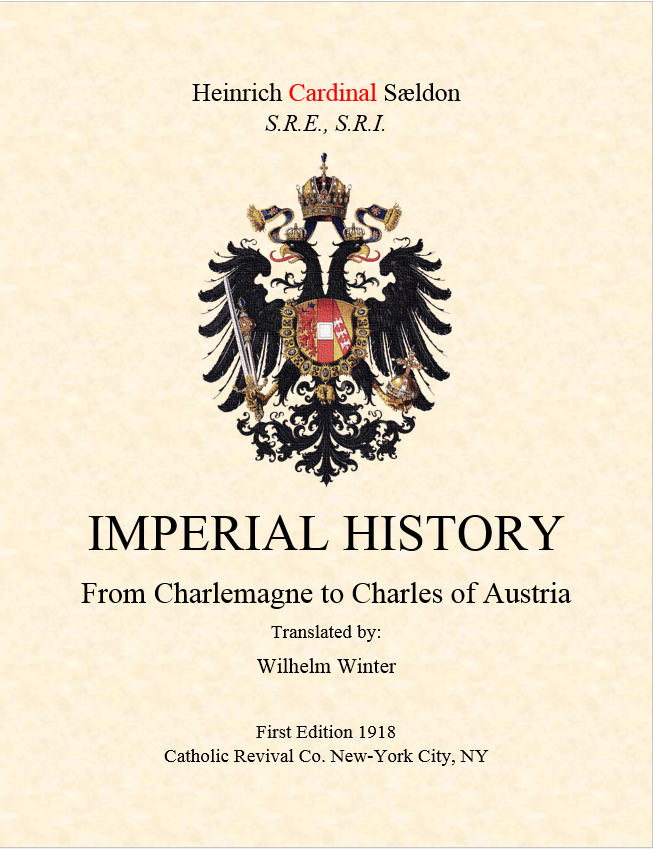
Scan of the Tittle-page of Cardinal Seldon’s IMPERIAL HISTORY, 1918 English Edition
An important and rare book, Cardinal Seldon’s Imperial History, is one of the few writings which preserves the enigmatic verses:
Wolves with the hair of Ermine
Crows that are crowned as Kings
Though these things be many as vermin
ONE shall outlast these things
In the mountains an EAGLE shall rise
The Flag of the Desert shall burn
Renewed forever shall be old allies
And the Knight Twice Crowned shall return
These verses are found elsewhere in fragmentary forms, the first verse often being misattributed to the revolutionary poet Swinburne (see: Hercule F. Duroc on the History of Heiligwaldenstein), and the second attributed (rightly or wrongly) to Tyrolean folklore. It is rumored that a third verse once existed beginning A SWORD shall be his token, but if this is so, the verse is lost.
“My sons, cultivate truth and piety; give no ear to evil counselors, never engage in unnecessary war, but when you are involved in war be strong and brave. Love peace even better than your own personal interests. Remember that the counts of Hapsburg did not attain their heights of reputation and glory by fraud, insolence or selfishness, but by courage and devotion to the public weal. As long as you follow their footsteps, you will not only retain, but augment, the possessions and dignities of your illustrious ancestors.”–Speech of Albrecht IV to his three sons, as attributed in The Empire of Austria; Its Rise and Present Power, by John S. C. Abbott.
Albrecht was the seventh count of Hapsburg and a count of Kyburg, the father of Holy Roman Emperor and King Rudolf I. When the call went forth from Theobald of Navarre the Count of Champagne for a Crusade in the Holy Land, Albrecht with his knights joined him. They went Southward from Acre and Albrecht fell in battle at Ascalon on the 13th of December 1239. This brave lord bequeathed both his courage and his wisdom (for which he was renowned) to his son Rudolf, who became arguably the greatest of the medieval Hapsburgs, and for his piety was rewarded by God.
In the first video below you will find one of the Crusader Songs of Theobald of Navarre, whom some call one of the greatest of medieval poets.
The second video is the Palästinalied by Wather von der Vogelweide, written about the same period.
Christians, Jews, and Muslims make this claim
God ordered it so, for His Triune Name
Our cause is right, for Christ we fight
And God in holy might will grant our right
In the first book of The War for Christendom, Tower of Ivory, the political situation is much different than it is today. Displayed on the map above are the main geopolitical forces, which are listed below: Continue reading →
True unity between Church and State, through Our Lord Jesus, Blessed Mary Ever-Virgin, and the Holy Rosary.
But there is a narrower sense in which Christendom stands for a polity as well as a religion, for a nation as well as for a people. Christendom in this sense was an ideal which inspired and dignified many centuries of history and which has not yet altogether lost its power over the minds of men. Catholic Encyclopedia: “Christendom”
Christendom is the temporal and cultural sphere of Catholicity, as opposed to the spiritual(i.e. the Catholic Church), a uniquely Catholic Civilization with the Pope as its supreme head, and the Emperor is its temporal and military head. To separate Catholicism and Christendom is to severely maim Catholicism, and leave it without a political, cultural, and military defender. It is not a “supra-national state,” but a unifying Civilization encompassing many states and cultures in accordance with the Catholic principle of Subsidiarity, having the Holy Roman Imperium as its highest temporal authority.


 The Crusades are often looked upon now days as an unjust aggression against a peaceful and superior culture. Yet that culture had invaded the Catholic Roman Empire, and had threatened to utterly destroy it. Good Catholic men (each with his wife’s permission, of course) would go forth to fight and more importantly to defend the remnants of true Civilization left to them (see my previous post on


 The War for Christendom