Hapsburg of the Month: Rudolf I, Holy Roman Emperor

Tags

, , , , , , , , , , , , ,

Ruda_HabsburgOne of the Greatest of the Sacretemporal (Medieval) Hapsburgs, Rudolf I was the eighth Count of Hapsburg, and the son of Count Albrecht IV, born on May 1, 1218.  Upon his father’s death on Crusade in 1239, he inherited the Hapsburg lands in Aargau and Alsace. A just count and a holy man, he had a personal devotion to the Holy Eucharist, which would be passed on to his descendants. A faithful Catholic, he was nevertheless briefly excommunicated for supporting his godfather the heretical Emperor Frederick II and Frederick’s son Conrad IV, however the excommunication was soon lifted upon Conrad’s death in 1254 Continue reading

A Spirit of High Adventure

Tags

, ,

Tower of Ivory cover1

Then they heard again the crashing of the waves on the rocky shore and saw the sunlight glittering like a thousand stars cast into the sea. And as they hurried away in opposite directions, each could feel in his heart a spirit of high adventure, and that this world was not such a bad place after all.

  John Lorran also felt this same spirit as he looked upon the sea, and he smiled. Thank God for the world, he thought, and it sang out in his mind as a mighty benediction on the earth. Thank God!”
Tower of Ivory Chapter IV –Coming Soon!

©2015 The Hapsburg Restorationist

From Knight in the Hapsburg Army to Holy Monk

Tags

, , , , , ,

SAINT BERNARDO TOLOMEI (1272-1348) (Canonized April 26, 2009 by Benedict XVI)

Abbot Founder, Olivetan Benedictine Congregation

From EWTN

TolomeiBernardoBERNARDO TOLOMEI, son of Mino Tolomei, was born in Siena on May 10, 1272. At his Baptism he was given the name “Giovanni”. He was probably educated by the Dominicans at their College of San Domenico di Camporeggio in Siena. He was knighted by Rudolph I of Habsburg (1218-1291). While studying law in his home town, he was also a member of the Confraternity of the Disciplinati di Santa Maria della Notte dedicated to aiding the sick at the “della Scala” Hospital. Due to progressive and almost total blindness, he was forced to give up his public career. In 1313, in order to realize a more radical Christian and ascetic ideal, together with two companions (Patrizio di Francesco Patrizi, d. 1347 and Ambrogio di Nino Piccolomini, d. 1338), both noble Sienese merchants and members of the same confraternity, he retired to a family property in Accona, about 30 km south-east of the city. It was here that Giovanni, who in the meantime had taken the name “Bernardo” out of veneration for the holy Cistercian abbot, together with his two companions, lived a hermitic penitential life, characterized by prayer, manual work and silence.

Continue reading

…Because They Love What They Left Behind

Tags

, , , , , , ,

Just War in THE WAR FOR CHRISTENDOM

The true soldier fights not because he hates what is in front of him, but because he loves what is behind him.” – G.K. Chesterton To Arms! The Crusades are often looked upon now days as an unjust aggression against a peaceful and superior culture. Yet that culture had invaded the Catholic Roman Empire, and had threatened to utterly destroy it. Good Catholic men (each with his wife’s permission, of course) would go forth to fight and more importantly to defend the remnants of true Civilization left to them (see my previous post on The Crusader Count). Now in our Modern Times we are externally more civilized, yet can we today defend the much fewer remnants of true Civilization left to us? Continue reading

Nothing “Middle” about the “Middle Ages”!

Tags

, , , , ,

It’s About Time We had a New (More Truthful) Name for “the Dark Ages”

CharlemagneAtCourt

Thanks to Isabella Rose, The Catholic Nomad, over at Reclaiming the Sacred, the so called “Medieval Period” will henceforward be know on this website as:

The Sacred Ages

And such things as were known as “Medieval” shall now be known as:

Sacretemporal

As this may seem confusing at first, I will continue to use the terms “Middle Ages” and “Medieval” in parentheses alongside these new terms.

“κῦδος” to The Catholic Nomad 🙂

The World of THE WAR FOR CHRISTENDOM: Cardinal Seldon’s Imperial History

Tags

, , , , , , , , , , , , ,

 It is our purpose in setting forth this history to provide the Faithful with a true understanding of the history of Christendom, and with hope for the future. The Empire may lie in ashes, but it was always from the ashes that the Phoenix rose again in glory.- Seldon’s Imperial History, “Preface”.

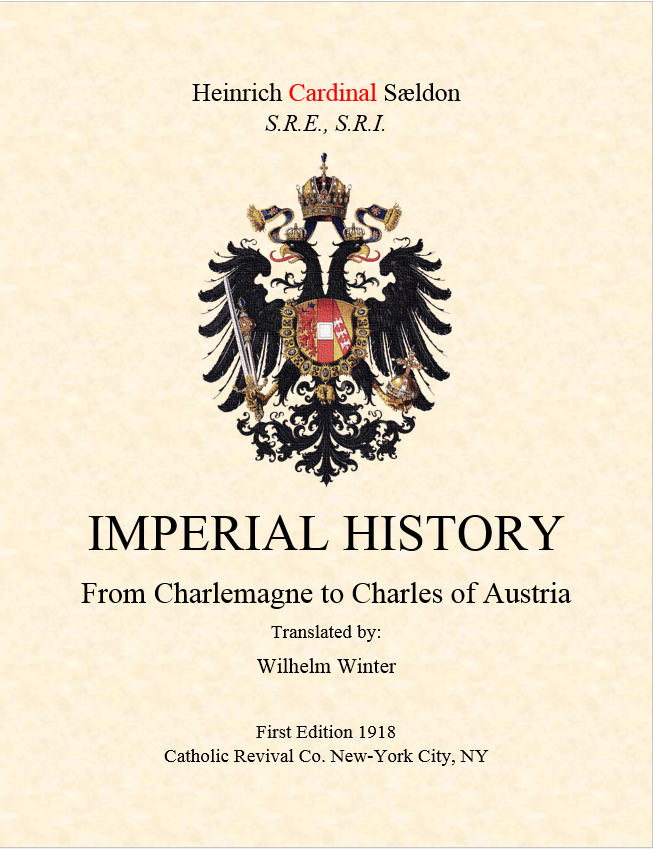
Seldon's IMPERIAL HISTORY

Scan of the Tittle-page of Cardinal Seldon’s IMPERIAL HISTORY, 1918 English Edition

An important and rare book, Cardinal Seldon’s Imperial History, is one of the few writings which preserves the enigmatic verses:

Wolves with the hair of Ermine
Crows that are crowned as Kings
Though these things be many as vermin
ONE shall outlast these things

In the mountains an EAGLE shall rise
The Flag of the Desert shall burn
Renewed forever shall be old allies
And the Knight Twice Crowned shall return

These verses are found elsewhere in fragmentary forms, the first verse often being misattributed to the revolutionary poet Swinburne (see: Hercule F. Duroc on the History of Heiligwaldenstein), and the second attributed (rightly or wrongly) to Tyrolean folklore. It is rumored that a third verse once existed beginning A SWORD shall be his token, but if this is so, the verse is lost.

Hapsburg of the Month: Albrecht IV the Wise, The Crusader Count

Tags

, , , , , ,

Albert_III_Alsace

“My sons, cultivate truth and piety; give no ear to evil counselors, never engage in unnecessary war, but when you are involved in war be strong and brave. Love peace even better than your own personal interests. Remember that the counts of Hapsburg did not attain their heights of reputation and glory by fraud, insolence or selfishness, but by courage and devotion to the public weal. As long as you follow their footsteps, you will not only retain, but augment, the possessions and dignities of your illustrious ancestors.”Speech of Albrecht IV to his three sons, as attributed in The Empire of Austria; Its Rise and Present Power, by John S. C. Abbott.

Albrecht was the seventh count of Hapsburg and a count of Kyburg, the father of Holy Roman Emperor and King Rudolf I. When the call went forth from Theobald of Navarre the Count of Champagne for a Crusade in the Holy Land, Albrecht with his knights joined him. They went Southward from Acre and Albrecht fell in battle at Ascalon on the 13th of December 1239. This brave lord bequeathed both his courage and his wisdom (for which he was renowned) to his son Rudolf, who became arguably the greatest of the medieval Hapsburgs, and for his piety was rewarded by God.

In the first video below you will find one of the Crusader Songs of Theobald of Navarre, whom some call one of the greatest of medieval poets.

The second video is the Palästinalied by Wather von der Vogelweide, written about the same period.

Christians, Jews, and Muslims make this claim
God ordered it so, for His Triune Name
Our cause is right, for Christ we fight
And God in holy might will grant our right

What is the INA?

Tags

, , ,

The InterNational Academy is the United Nations’ advanced officer training facility for cadets in the Conscriptee Program. Located on an uncharted nearly inaccessible rocky isle in the North Atlantic, the main base is a ivory octagonal tower, heavily guarded. The facility’s current commander is a certain Colonel Branden, a high rankly UN official who reports directly to the President of the Security Council, Gen. Tervagan Eisengrimm. Strangely enough, the INA is a point of international tension between the UN and its allies, the Golden Caliphate and the Gòngchǎn Sphere, who press Eisengrimm to disband it.