The Empire and Nationalism: Henry VIII’s Role In The Fragmentation Of Christendom

Tags

, , , , , , ,

Workshop_of_Hans_Holbein_the_Younger_-_Portrait_of_Henry_VIII_-_Google_Art_ProjectNationalism is a threat to the International Good, a subversion of true Patriotism. Its fruits are self-evident; endless war, tyrannical Statism, the Annihilation of Nations, and violent Racism. Yet despite these plainly visible effects, we live today in a Nationalistic world. Without a comprehensive International System or indeed Worldview, Civilization will kill itself, and yet that is exactly what is happening. The question is not when will it happen, the question is why is it happening now? Continue reading

Sci-Fi Saturday: The Imperial Space Fleet (A Random Day’s Post)

Tags

, , , , , , , , , ,

Besides my work as the Head of the English Speaking Branch of the HRM and my work on The War for Christendom book series, I have also written a few works of science fiction (sci-fi), specifically the (as-of-yet) unfinished St. Damian’s Chronicles: Tales of Catholicism Amongst the Stars. The St. Damian’s Chronicles are a sort of Asimov’s Foundation about Catholics on different colony planets struggling to survive and spread the Faith.

(This Paragraph is for those of you who have no idea what Isaac Asimov’s Foundation series is.) The basic premise of the Foundation is that a Statistical Wizard named Hari Seldon predicts the fall of a Galactic Empire (unlike Star Wars this is good empire) and sets up a group of scientists who use religion and money to gain control of surrounding barbarians in order to create a second Galactic Empire. They botch the job and Psychologists/Psychiatrists rush in to save the day. (Enough summarizing, back to the main post.)

The St. Damian’s Chronicles‘ analog to Foundation would be incomplete without a corresponding Empire and Starfleet, so without further fanfare, I present:

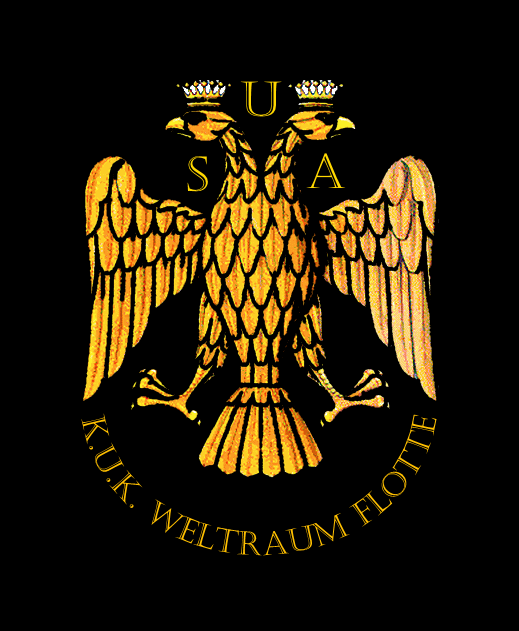
The K.U.K. Space Fleet

KUK Space Fleet+

Continue reading

The Great Feast: The Hapsburgs And Corpus Christi

Tags

, , , , , , , , , , ,

Hapsburgs Corpus ChristiIn 1264, Pope Urban IV issued the Papal Bull Transiturus de Hoc Mundo, promulgating to the Latin Rite the Solemn Feast of the Body and Blood of Christ, to be celebrated on the first Thursday after Trinity Sunday. Around this same time, Rudolf the eighth Count of Hapsburg aided and protected a priest bringing the Viaticum to a dying farmer, giving the priest his horse and guiding him across a raging torrent, walking bareheaded. The priest then prophesied that the humble Count and his descendents would receive the Imperium of the Holy Roman Empire.

Continue reading

The World of THE WAR FOR CHRISTENDOM: The UN and the Reichsidee

Tags

, , , , , , , , ,

“The cross on the flag,” and here he pointed to the symbol which represented the United Nations, the governing body of a majority of the civilized world, a government with the power to control the earth, “has been twisted out of shape into a circle, the sign of a devouring self-absorption, and the laurel that surrounds it is the faded glory of this world-”- Tower of Ivory Chapter I-Coming Soon!

The conflict presented in The War for Christendom is not only a physical war, but an ideological conflict and in a sense a symbolic conflict. It is a war between two Crosses, and there is a world of difference between the two.

The first Cross is the Twisted Cross, the cross bent into a shape not its own, it is the divinization of the State as the supreme good, an absolute Statism. In The War for Christendom, this worship of the state is the philosophy of a future United Nations, what the present UN could become, for the dangerous tendency is present.

In contrast to this Statism is the old Holy Empire governed by the Reichsidee, the idea of an International Law based on the Catholic principle of subsidiarity and the Common Good. The common man and the nation to which he belongs are protected by a Higher Authority, while he himself defends this Authority; truly symbolized by the Cross, for the Cross is made of two parts, each supporting the other, of Authority and Liberty each in its proper place; in a word, Freedom within the Law.
International Good And The Political Order: The Reasons For A Holy Roman Empire

Tags

, , , , , , , , ,


CharlemagneAtCourtAll of Modern Political Thought (based on Modern Philosophy) has been neatly summarized in a diagram known as the Pournelle Axes:
axes

Yet all this diagram presents is a choice of evils, absolute Statism on one hand and absolute Anarchism on the other; the State as the absolute good or the Individual’s Destructive Tendencies, neither of which is ordered toward the Common Good, which is and must be the true end of all governance. Continue reading

Some Questions (And A Few Answers)

Tags

, , , , ,

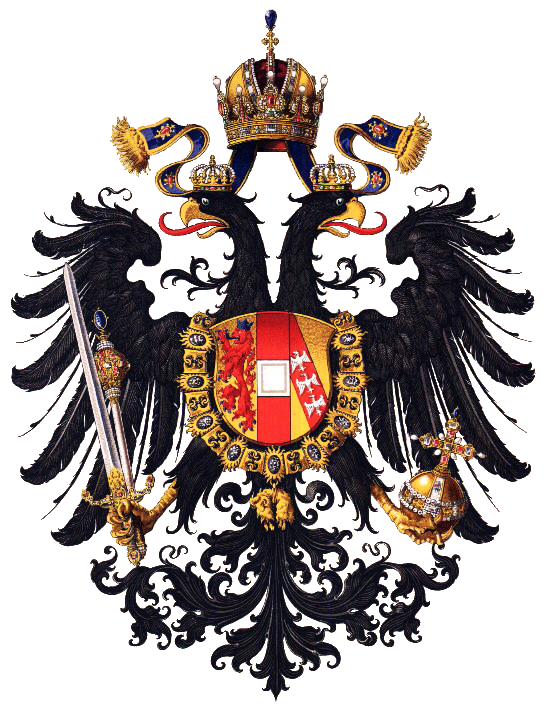
Wappen_Kaisertum_Österreich_1815_(Klein)

Why I Am Writing

Q. What was your first contact with the Hapsburgs, and what began The War for Christendom book series? 

About two years ago, I (a Catholic writer with no published works to speak of- yet) wrote a short story entitled The Citadel. Set in the not too distant future, The Citadel is the story of a recently elected Pontiff forced to flee Rome, pursued by the combined forces of Islam and a corrupted United Nations, as told through the eyes of the young general of the Pope’s guard. A general named John Lorran. Continue reading

Emperor Charles V’s Response to Luther at Worms

Tags

, , , , , , , , ,

Anthony_Van_Dick_-_Ritratto_equestre_dell'imperatore_Carlo_V_-_Google_Art_Project

You know that I am born of the most Christian Emperors of the noble German nation, of the Catholic Kings of Spain, the Archdukes of Austria, the Dukes of Burgundy, who were all to the death true sons of the Roman Church, defenders of the Catholic Faith, of the sacred decrees and customs of its worship, who bequeathed all this to me as my heritage and according to whose example I have hitherto lived. Thus I am determined to hold fast…

For it is certain that a single monk must err if he stands against the opinion of all Christendom. Otherwise, Christendom itself would have erred for more than a thousand years. Therefore I am determined to set my kingdoms and dominions, my friends, my body, my blood, my life- my soul upon it.

 “More than any pope, more than any saint, [Charles V] saved Christendom-” The Man Who Saved Christendom, Dr. Warren Carroll (available here)

Pope Leo XIII on the Holy Roman Empire

Tags

, , , , , ,

But from the time when the civil society of men, raised from the ruins of the Roman Empire, gave hope of its future Christian greatness, the Roman Pontiffs, by the institution of the Holy Empire, consecrated the political power in a wonderful manner. Greatly, indeed, was the authority of rulers ennobled; and it is not to be doubted that what was then instituted would always have been a very great gain, both to ecclesiastical and civil society, if princes and peoples had ever looked to the same object as the Church. And, indeed, tranquility and a sufficient prosperity lasted so long as there was a friendly agreement between these two powers. If the people were turbulent, the Church was at once the mediator for peace. Recalling all to their duty, she subdued the more lawless passions partly by kindness and partly by authority. So, if, in ruling, princes erred in their government, she went to them and, putting before them the rights, needs, and lawful wants of their people, urged them to equity, mercy, and kindness. Whence it was often brought about that the dangers of civil wars and popular tumults were stayed.

Diuturnum Illud (On the Origin of Civil Power)- Encyclical of Pope Leo XIII

Pope Pius II on the House of Hapsburg

Tags

, , , , , ,

Pintoricchio_002a

The Marriage of Holy Roman Emperor Frederick III of Hapsburg and Eleonora of Portugal, officiated by Pope Pius II

The princes of the sublime house of Austria, which ranks among its members many kings and emperors, deemed themselves secure of success only when they served the Supreme Being with fidelity and constancy.

The Sacretemporal (Medieval) Respect for Women

Tags

, , , , , , , ,

The Ritter (Knight) Hartmann Von Aue, who is considered today one of the three Greatest Imperial Poets, was a Crusader, a songwriter, and the author of several narrative poems, among them the profoundly beautiful Epic of True Love, Der arme Heinrich (if you have not read this great work, I encourage you to at least familiarize yourself with the story).

CodexManesseFol184vHartmannVonAue

Herr Hartmann was very much a man of his times, especially in his view of women. In modern times we are taught to look down on the Sacred Ages, with their alleged oppression of women, yet it is precisely in modern times that we see women oppressed, and forced from their natural complementarity with men. The true Sacretemporal view of women as in a very true sense equal and complementary is most beautifully expressed these few lines of Hartmann’s profound poetry:

Glory be unto her whose word
    Sends her dear lord to bitter fight;
  Although he conquer by his sword.
    She to the praise has equal right;
  He with the sword in battle, she at home with prayer.
    Both win the victory, and both the glory share.