Q. What was your first contact with the Hapsburgs, and what began TheWar for Christendom book series?
About two years ago, I (a Catholic writer with no published works to speak of- yet) wrote a short story entitled The Citadel. Set in the not too distant future, The Citadel is the story of a recently elected Pontiff forced to flee Rome, pursued by the combined forces of Islam and a corrupted United Nations, as told through the eyes of the young general of the Pope’s guard. A general named John Lorran. Continue reading →
You know that I am born of the most Christian Emperors of the noble German nation, of the Catholic Kings of Spain, the Archdukes of Austria, the Dukes of Burgundy, who were all to the death true sons of the Roman Church, defenders of the Catholic Faith, of the sacred decrees and customs of its worship, who bequeathed all this to me as my heritage and according to whose example I have hitherto lived. Thus I am determined to hold fast…
For it is certain that a single monk must err if he stands against the opinion of all Christendom. Otherwise, Christendom itself would have erred for more than a thousand years. Therefore I am determined to set my kingdoms and dominions, my friends, my body, my blood, my life- my soul upon it.
“More than any pope, more than any saint, [Charles V] saved Christendom-” The Man Who Saved Christendom, Dr. Warren Carroll (available here)
The Marriage of Holy Roman Emperor Frederick III of Hapsburg and Eleonora of Portugal, officiated by Pope Pius II
The princes of the sublime house of Austria, which ranks among its members many kings and emperors, deemed themselves secure of success only when they served the Supreme Being with fidelity and constancy.
One of the Greatest of the Sacretemporal (Medieval) Hapsburgs, Rudolf I was the eighth Count of Hapsburg, and the son of Count Albrecht IV, born on May 1, 1218. Upon his father’s death on Crusade in 1239, he inherited the Hapsburg lands in Aargau and Alsace. A just count and a holy man, he had a personal devotion to the Holy Eucharist, which would be passed on to his descendants. A faithful Catholic, he was nevertheless briefly excommunicated for supporting his godfather the heretical Emperor Frederick II and Frederick’s son Conrad IV, however the excommunication was soon lifted upon Conrad’s death in 1254 Continue reading →
It is our purpose in setting forth this history to provide the Faithful with a true understanding of the history of Christendom, and with hope for the future. The Empire may lie in ashes, but it was always from the ashes that the Phoenix rose again in glory.- Seldon’s Imperial History, “Preface”.
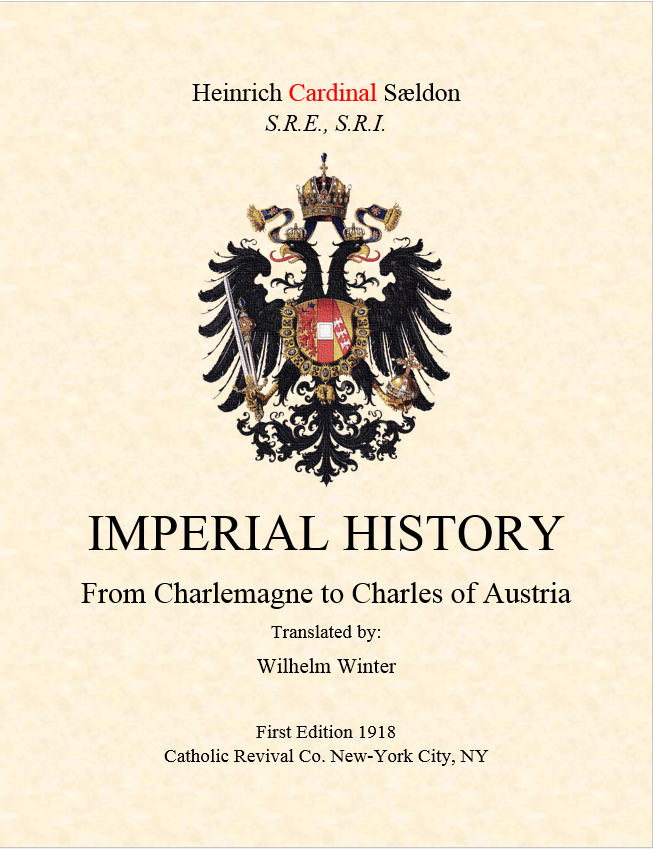
Scan of the Tittle-page of Cardinal Seldon’s IMPERIAL HISTORY, 1918 English Edition
An important and rare book, Cardinal Seldon’s Imperial History, is one of the few writings which preserves the enigmatic verses:
Wolves with the hair of Ermine
Crows that are crowned as Kings
Though these things be many as vermin
ONE shall outlast these things
In the mountains an EAGLE shall rise
The Flag of the Desert shall burn
Renewed forever shall be old allies
And the Knight Twice Crowned shall return
These verses are found elsewhere in fragmentary forms, the first verse often being misattributed to the revolutionary poet Swinburne (see: Hercule F. Duroc on the History of Heiligwaldenstein), and the second attributed (rightly or wrongly) to Tyrolean folklore. It is rumored that a third verse once existed beginning A SWORD shall be his token, but if this is so, the verse is lost.
“My sons, cultivate truth and piety; give no ear to evil counselors, never engage in unnecessary war, but when you are involved in war be strong and brave. Love peace even better than your own personal interests. Remember that the counts of Hapsburg did not attain their heights of reputation and glory by fraud, insolence or selfishness, but by courage and devotion to the public weal. As long as you follow their footsteps, you will not only retain, but augment, the possessions and dignities of your illustrious ancestors.”–Speech of Albrecht IV to his three sons, as attributed in The Empire of Austria; Its Rise and Present Power, by John S. C. Abbott.
Albrecht was the seventh count of Hapsburg and a count of Kyburg, the father of Holy Roman Emperor and King Rudolf I. When the call went forth from Theobald of Navarre the Count of Champagne for a Crusade in the Holy Land, Albrecht with his knights joined him. They went Southward from Acre and Albrecht fell in battle at Ascalon on the 13th of December 1239. This brave lord bequeathed both his courage and his wisdom (for which he was renowned) to his son Rudolf, who became arguably the greatest of the medieval Hapsburgs, and for his piety was rewarded by God.
In the first video below you will find one of the Crusader Songs of Theobald of Navarre, whom some call one of the greatest of medieval poets.
The second video is the Palästinalied by Wather von der Vogelweide, written about the same period.
Christians, Jews, and Muslims make this claim
God ordered it so, for His Triune Name
Our cause is right, for Christ we fight
And God in holy might will grant our right



 The War for Christendom