Tags
This essay was originally composed in May, 2025.
The proper study of the political philosopher is not politics, but polity. Our ways of being in community are at once universal and confined, contingent upon particular historical and cultural conditions and timelessly imbued with an eternal legitimacy. Provided that the foundation is secure, the habitat of political animals will endure numerous alterations, some better and some worse, easily undone or practically impossible to remove. But alas, the foundation has crumbled away, and we dwell not in the proverbial house of cards, but in the wrecked ruins of a civilization far older than our own, tottering above and about us as stone by stone slips into the unrelenting sea.
A house that is built on sand will not stand- but what is our political terminology other than ever-shifting dunes that imperceptibly but inexorably leave us behind, stranded without solid ground? Right and left, left and right, the old mazurka plays on, and each election is a little more out of tune. But sometimes the refrain comes in again, more clearly than the last time it was played.
There was a kingdom – this is not a fairy tale, but a more ancient mode – there was a kingdom once which endured great travails. In the end, it slipped from that high destiny through famine and war, to become instead a nation, and in the end, a nightmare. When men are united solely by blood, how often is it blood spilt rather than blood shared. Gunpowder and the guillotine together mark the maturation of modernity. Man does not live by bread alone, but hangs breathlessly on the words of philosophes, who inform him that he is a lion in a nation of sheep, and that he belongs to a nation of lions in a world of wolves.
The words of the philosophes are not the only watchwords of the people, or rather of the populists. This time around, the revolutionaries were not in the avant but the rearguard. For they preached Unité, everyone must assimilate, be digested in the great stomach of the revolutionary regime, regurgitated as an identity-less ethno-linguistic mass. Propriété, rationalized divide et subiecte, the checkerboard map with its easily digestible chunks lacking in texture, nuance be damned. And Sûreté, the prison writ large, the concentration camp large enough to encompass a host of peoples, the watchful eyes of spies and informers under the shadow of the inevitable axe. Don your liberty caps, comrades, citizens! You will never be free again.
Of course, this was long ago as men reckon time, centuries ago, and Liberté, Egalité, and Fraternité have had a longer-lasting impact on our memories. So too has the legacy of Napoleon, who blundered through triumphs into failures with an impeachable blend of bombast and style. Perhaps as time draws closer to its natural ending, it compresses. Certainly we now wear the scarlet caps and the pseudo-imperial laurels together. But it is not enough to recall the old words, for the present decade we will need new terms to anchor our framework against the shifting tides.
The first of these terms in our 21st century topography is Technocratic Populism. The Force of the old nationalists has been leveraged and redirected, through the mechanisms and webs that net unwary men, baited with promised immortality. These are not honest mechanics but naïve Faustians, for they never learnt that fundamental rule of their art, that machines are powerful servants but impotent masters. And so each in turn bows and reverences, not divine Reason, but inhuman intelligences. Their deity is not the loving Omnipotent nor the cold calculating goddess but the Basilisk, and his piercing hypothetical gaze has already turned their hearts to stone.
Among these new philosophes another parable is told, though this one has not yet come to pass. Faustus has once again summoned Mephistopheles, and set him the task of making paper clips – doubtless to bind together his reams of blog-posts, podcast transcripts, and tweets. And so the demon does, making them first out of the silverware, then finding this inadequate to his task, out of Faustus’ books, his hounds, his house, his city and all its inhabitants. The magician returns to find all his works buried under a mountain of metal, while his spectral servant cries out with glee: “Master! See just how efficient I am!”
To what end, then, do these acolytes of king serpent wield their increasing influence? Against the corrupt elites, they appeal, the modern aristos who feast upon insects while the rest of us are forced to gorge on cake. To wage a campaign of retribution against somnambulists, they pride themselves on their insomnia. They are the reactionary shadow of all they despise. Dark elves with twisted Palantirs, who are as open about their power as their opponents are secret. Sound, sound the carmagnole! My heart goes out to you, people of France!
I started this essay with the statement that the proper study of the philosopher is not politics, but what we have before is hardly politics at all. Here there is not, as the last true Emperor once wrote, “an objective investigation of the nature of the State and the great forces that shape it, and the means by which these forces can be employed for the well-being of the community.” Instead, everything is “vibrations,” contentless, substanceless forces that irritate the aggregate mass in one direction or another. The golden age is coming, the golden age is here! And we shall live forever, now that we have Midas enthroned.
Midas is a totem of our infirmities, just as today our “totemic leaders” symbolize our inadequacies. In our modern political game of tarocco, coins may capture cups, swords swallow clubs, but the ultimate trump card is still The Fool. After all, the “vibes” are just memes, and memes are simply jests. The joker as well as the king wears a crown. But he does not wear it well. Tell the joke long enough and it loses its edge. The dull blade cuts more painfully and slowly than the sharp. Here we return to a theme from earlier, the reduction of complexities, the rejection of nuance. It is essential to a meme that its subject be extremely complex and intricate, and rendered with all the nuance of a stick figure chiseled into a concrete block with a sledgehammer. The essence of all memes is reduction to the lowest level of meaning.
And here, at the lowest level, we arrive at the “based”. After all, populism is only effective if it appeals to the base, the oppressed, depressed, debased base. Trodden down by the bug-eyed, bug-eating urban elites, the suburban poor, with their cybertrucks and student loans must band together against the omnipresent Fourth Estate. Le Journal est mort, vive la tick-tock!
Of course it was lies that begat these lies. But the old lies often wore a fair cloak and just enough plausibility to be almost modest, practically half-decent. The new lies are naked, save for a coating of historically implausible “tradition” which washes them like the Celtic warrior covered in woad. But underneath, plainly visible, is the heartless sneer of the orc. The self-proclaimed “dark elves” have chosen their shock-troops in the digital trenches, and feed them on resentment until the blood frenzy sets in.
“Orc-posting” is the key battlefield tactic, the endless stream of “based content” generated by the artifice of larger and larger statistical parrots. Once the revolutionary mob could shout itself hoarse, long enough to let silence and reflection spoil the mood (and their appetite). But now ceaseless, like diabolical seraphim, they speak forever with tongues of electricity, and gesticulate with oddly numbered fingers unnaturally generated, in unholy imitations of art. This torrent dulls the mind into a hyper-hypnotic state where reality itself appears unreal, the wasteland of the senses.
Do not for a moment think that because I have denounced the Montagnards, I have therefore embraced the Hébertists – I would not trade Robespierre for red Jacques Roux! The solution to this insomniac state is not to “go woke,” but to get a good night’s rest, and start afresh in the morning. The victim of this hypnosis will be brought out of it, dazed, confused, and totally disoriented. Naturally his first impulse will be to head in the opposite of the direction he was headed in under its influence. But this is the circular path that will lead him back under its spell. His true course is clear, he must stop moving entirely.
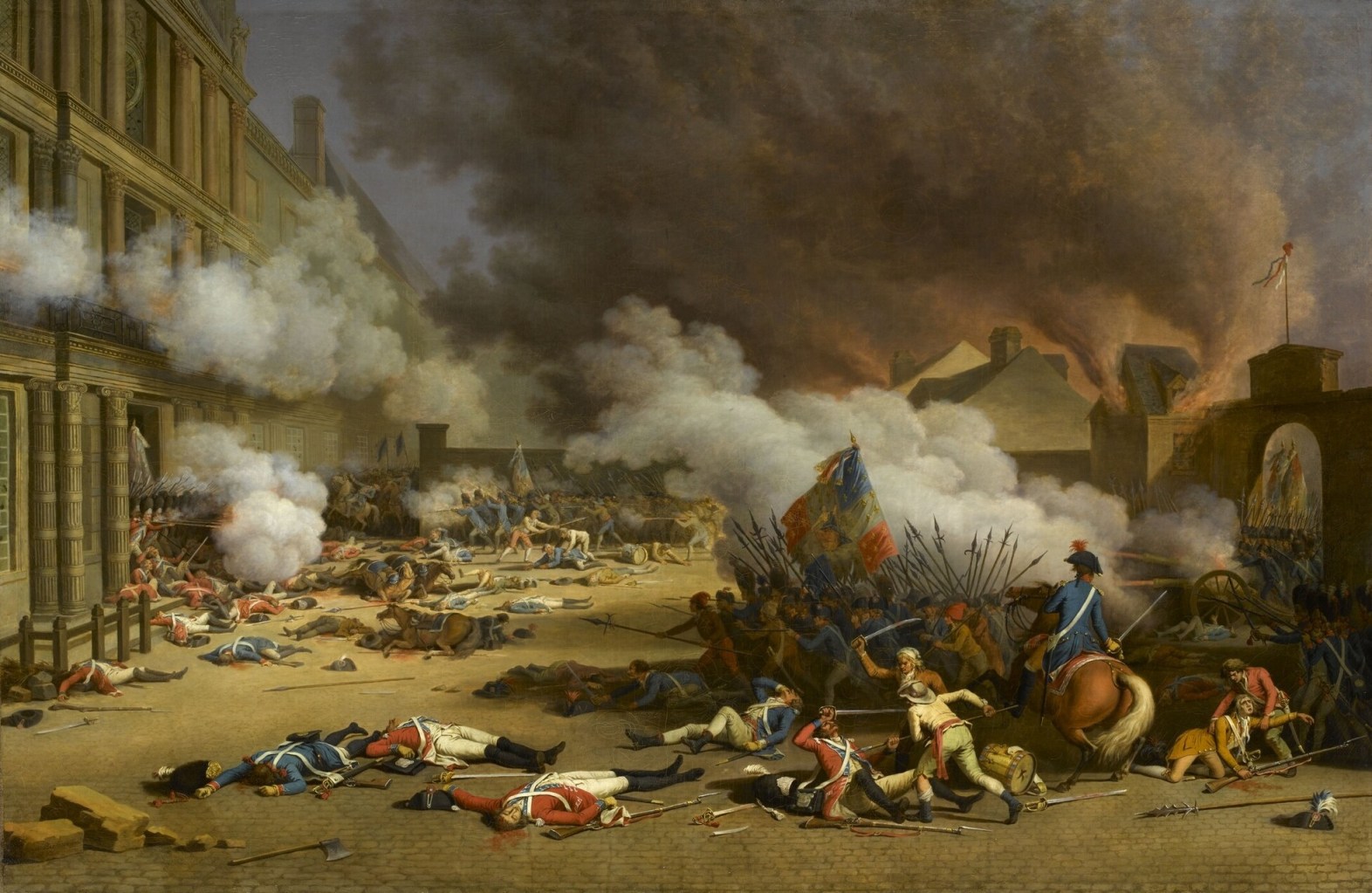
Far, far from the turmoil and tumults of the capitol and its numerous stormings (of the Bastille, of Versailles, of the Tuileries), by the river Vendée, peasant and artisan, farmer and noble, together took a stand against the popular tide. And as they stood and battled, and sweated and bled, they knew that they stood firm on solid ground. Their laurels are the ivy and their applause is the silence of the sea.
 The War for Christendom